Office Wall with door for manufacturing company
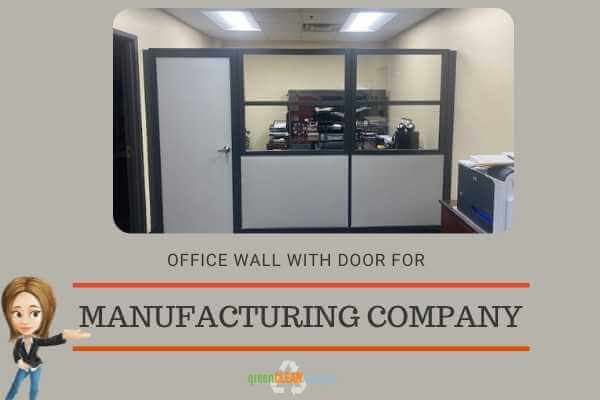
Manufacturing offices have a unique challenge. The production floor is loud, but the office staff still needs to see what is happening out there. This install in Cullman, Alabama shows how we solved both problems — privacy and visibility — with a single wall-to-wall cubicle panel configuration.
The Problem — An Open Office on a Loud Manufacturing Floor
The client’s office had no door separating it from the manufacturing floor. Every conversation competed with production noise, and there was no way to close off the space for a phone call or a private meeting. The office needed a wall with a door, but traditional drywall construction was not an option — the client wanted something that could be reconfigured if the office layout changed and did not require a contractor.
The Solution — 82″ Tall Cubicle Panels with Glass Windows and a Swing Door
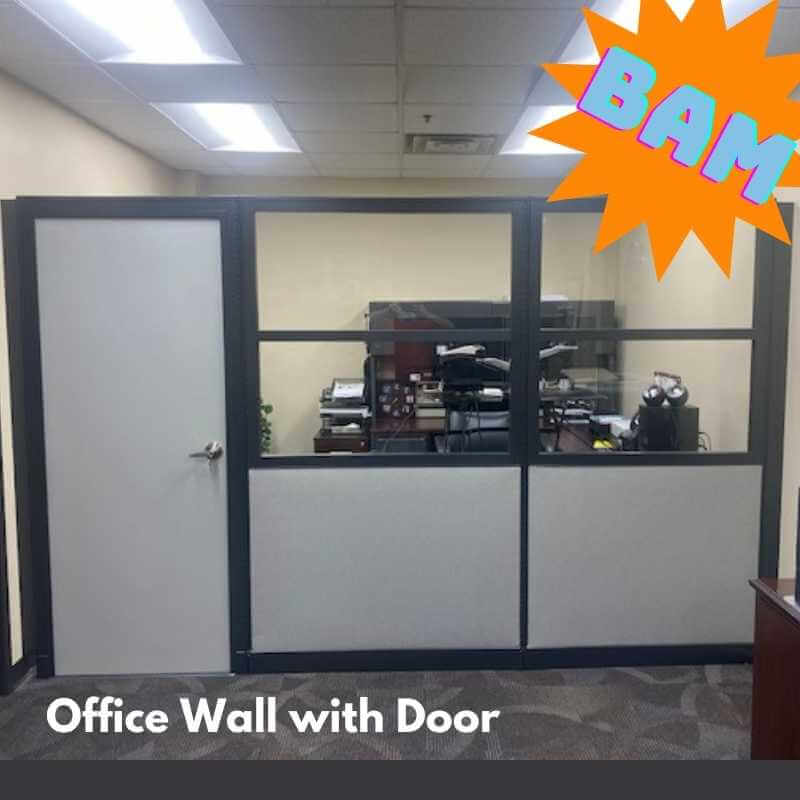
We built an office wall using 82″ tall modular cubicle panels that span from one existing wall to the other. The configuration includes a swing door for easy access and glass windows across the top section of the panels. The glass serves two purposes: it lets natural light flow between the office and the manufacturing floor, and it allows people to see when the client is in her office without needing to open the door and let the noise in.
At 82″ tall, the panels provide substantial sound reduction from the production floor while the glass windows maintain the visual connection to the shop that manufacturing managers need.
How Wall-to-Wall Cubicle Panels Work — Custom Fit Between Existing Walls
One of the most common questions we get about wall-to-wall configurations is how the panels fit perfectly between two existing walls. Modular cubicle panels come in increments of half a foot, so there is almost always a gap between the last panel and the wall. Here is how we solve that.
We use wall shims — filler pieces that span the remaining distance between the last cubicle panel and the existing wall. The shims are painted to match the color of the modular cubicle panel trim so the finished result looks like one continuous wall. We install shims on both ends of the new wall for a clean, built-in appearance.
The process starts with exact measurements of the space. We calculate how many standard-width panels fit between the two walls, determine the remaining gap on each side, and custom-cut the shims to fill those gaps precisely. The result is a wall that looks permanent but can be disassembled and reconfigured if the office layout changes down the road.
This same technique works for any wall-to-wall configuration — whether you need a single wall to divide a room or a full enclosed office with multiple walls and a door. For more details on cubicle wall panel heights and configurations, we cover everything from 42″ open workstation panels up through 85″ full standing privacy.
Wall-to-Wall Configuration for a University in Chicago
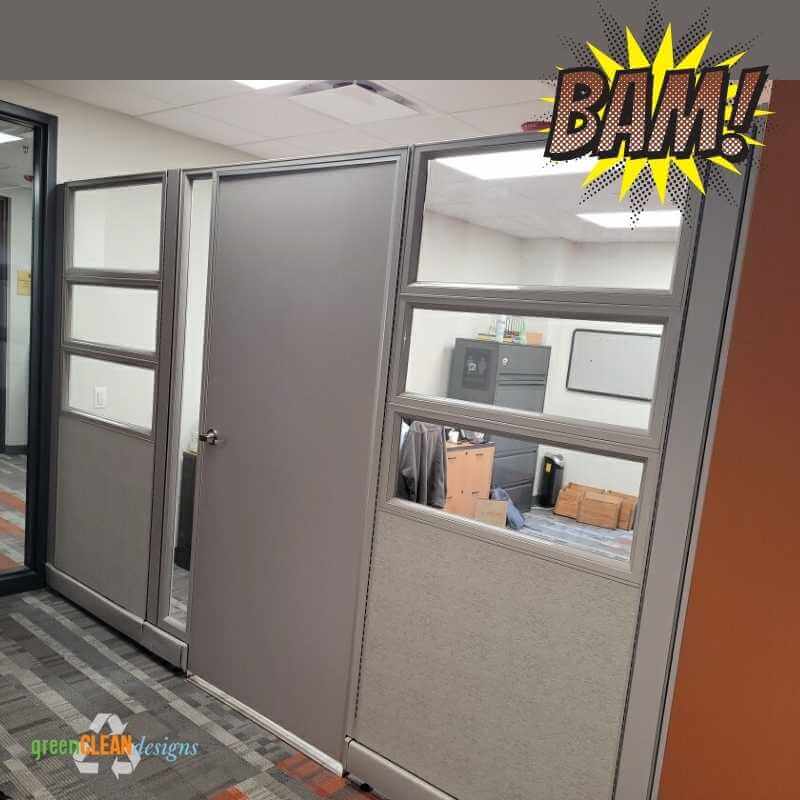
We used the same wall-to-wall approach for a university in Chicago, Illinois. This install used 85″ tall panels — a few inches taller than the Cullman manufacturing project — to create enclosed office spaces within a larger open area.
The taller panels at 85″ provide near-complete sound isolation between spaces, which matters in a university setting where offices are often adjacent to common areas, classrooms, or student traffic. The same shim technique was used to create a seamless fit between existing walls.
Whether it is a manufacturing company that needs to block production noise or a university that needs to carve offices out of an open floor plan, wall-to-wall cubicle panel configurations are one of the most versatile solutions we install.
Why Cubicle Panels Instead of Drywall?
For manufacturing companies and other businesses that need to create enclosed offices, cubicle panels offer several advantages over traditional drywall construction:
No contractor required. Cubicle panels are modular and install without the permits, drywall dust, or multi-week timelines that come with construction. We handle the entire install.
Reconfigurable. If your office layout changes — and in manufacturing, it often does — cubicle panels can be disassembled and reconfigured. Drywall is permanent.
Faster timeline. A wall-to-wall cubicle panel install takes days, not weeks. Your office is operational faster.
Glass options. Integrating glass windows into a cubicle panel wall is standard. With drywall, adding windows means framing, cutting, and finishing — significantly more labor and cost.
Sound control. At 85″ tall with fabric panels, the sound reduction is beneficial. Add glass at the top and you maintain visibility without sacrificing much acoustic performance. For even more sound isolation, pair the panels with a sound masking system.
If you are considering cubicles with doors for your manufacturing office, we have configurations from 85″ up to 107″ tall with swing doors, sliding doors, and glass options.
Furnishing the Entire Manufacturing Office? Here Is What We Recommend
The wall-to-wall cubicle configuration on this page solved one problem — giving the office staff private spaces in an open floor plan. But most manufacturing companies need more than walls and doors. You have front office staff, supervisors, a break room that gets heavy use across shifts, and a training area for safety meetings. Here is what we recommend for a full manufacturing office buildout.
Private Offices with Doors for Supervisors and Management
The wall-to-wall configuration on this page is one way to create enclosed offices. If your layout has open floor space rather than existing walls to anchor to, our freestanding cubicles with doors give you the same privacy without any attachment to the building structure. We build these from 82″ to 107″ tall with swing or sliding doors. For a manufacturing environment where noise from the shop floor bleeds into the office, taller panels with solid construction make a noticeable difference.
Open Workstations for Support Staff
Not every role needs a door. For administrative staff, purchasing, and shipping coordinators, cubicle wall panels in 53″ to 67″ heights provide seated privacy while keeping the office collaborative. These are the same panel systems used in the wall-to-wall build on this page — just configured as individual workstations instead of room dividers. Pair them with an L-shaped worksurface and you have a functional workstation at a fraction of the cost of a private office.
Executive Desks for the Front Office
If your plant manager or operations director needs a desk that fits a private office, we custom-build executive U-shaped desks and L-shaped desks in laminate, wood, and industrial styles. We size every desk to the room — manufacturing offices often have non-standard dimensions, and a custom desk eliminates the dead space that off-the-shelf furniture leaves behind.
Break Room Furniture Built for Shift Work
Manufacturing break rooms take more abuse than a typical corporate lunch room. Shift changes mean the room is in use around the clock, and the furniture needs to hold up. We carry commercial break room tables and seating designed for heavy daily use — laminate tops that resist scratching, steel frames that do not wobble after six months, and chairs that stack for easy cleaning. If your break room doubles as a meeting space, we have tables that fold and nest for quick reconfiguration.
Training Tables for Safety Meetings and Onboarding
Every manufacturing facility runs safety training, OSHA reviews, and new hire orientation. If you are using the break room for training because you do not have a dedicated space, training tables that fold and roll give you a classroom setup when you need it and clear floor space when you do not. These nest together for compact storage — useful when floor space is already tight.
Office Dividers and Privacy Panels
For areas where you need separation without a full cubicle system — between the front office and the shop entrance, around a reception area, or to screen off a supervisor’s desk — our freestanding office dividers come in heights from desk-level to floor-to-ceiling. The acoustic options help with noise from the production floor, and the panels are modular so you can reconfigure as your office layout changes.
We design manufacturing offices as complete projects. That starts with a rough layout based on your floor plan, moves to a rendering so you can see exactly what the space will look like, and ends with finish and color selection. If you are planning a manufacturing office buildout — whether it is 3 offices or 30 workstations — contact us and we will put together a design. Email nikim@greencleandesigns.com or call/text 913-701-4847.
Office Design Tips
Join our email list to receive our 5 Best Office Design Tips!